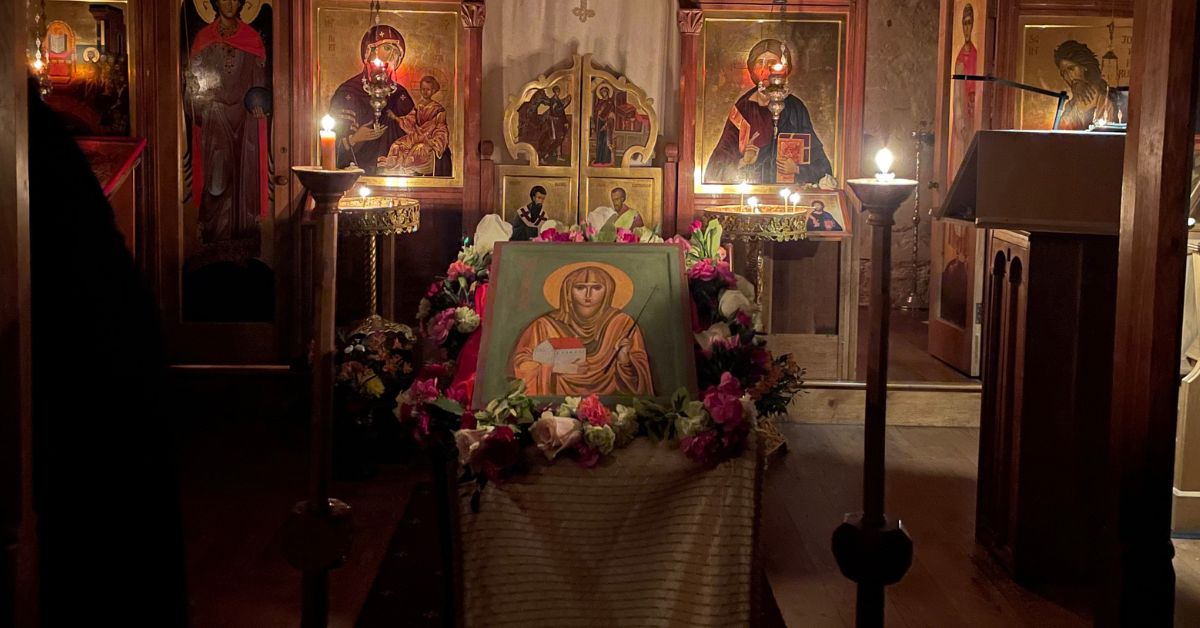
On the twenty-fifth day of June, we commemorate the finding and the translation of the precious relics of our Venerable Mother Milburga, daughter of the king of Mercia, abbess of Wenlock, the wonder-worker.
Verses
Like one who finds great spoil we now rejoice
At the finding of your relics, Milburga.
On the ninth of the Kalends of June Milburga’s relics were unearthed.
Synaxarion
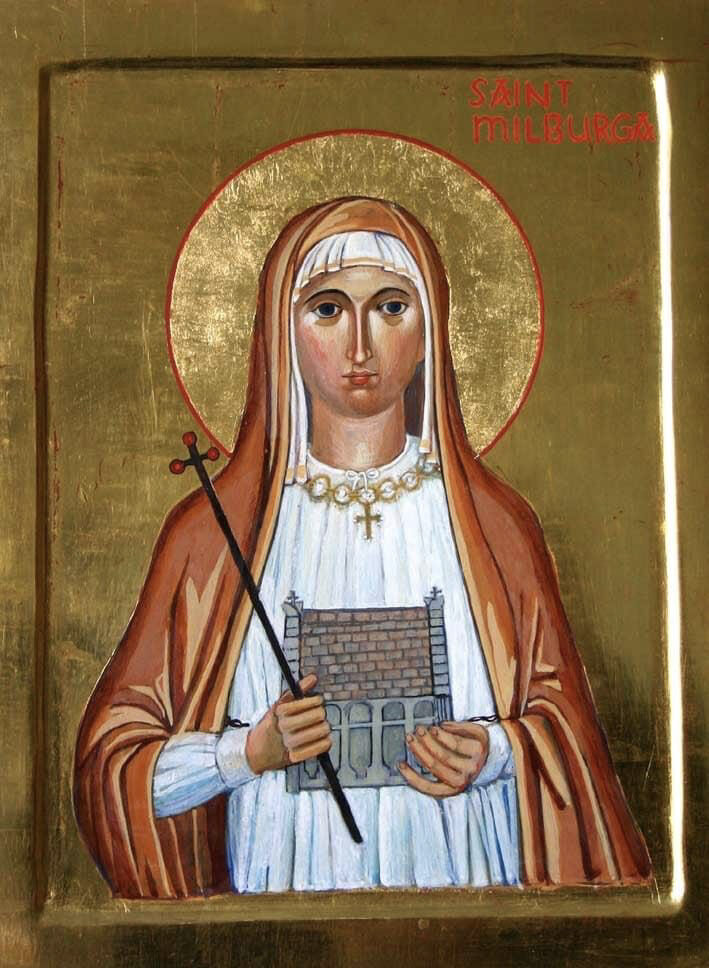
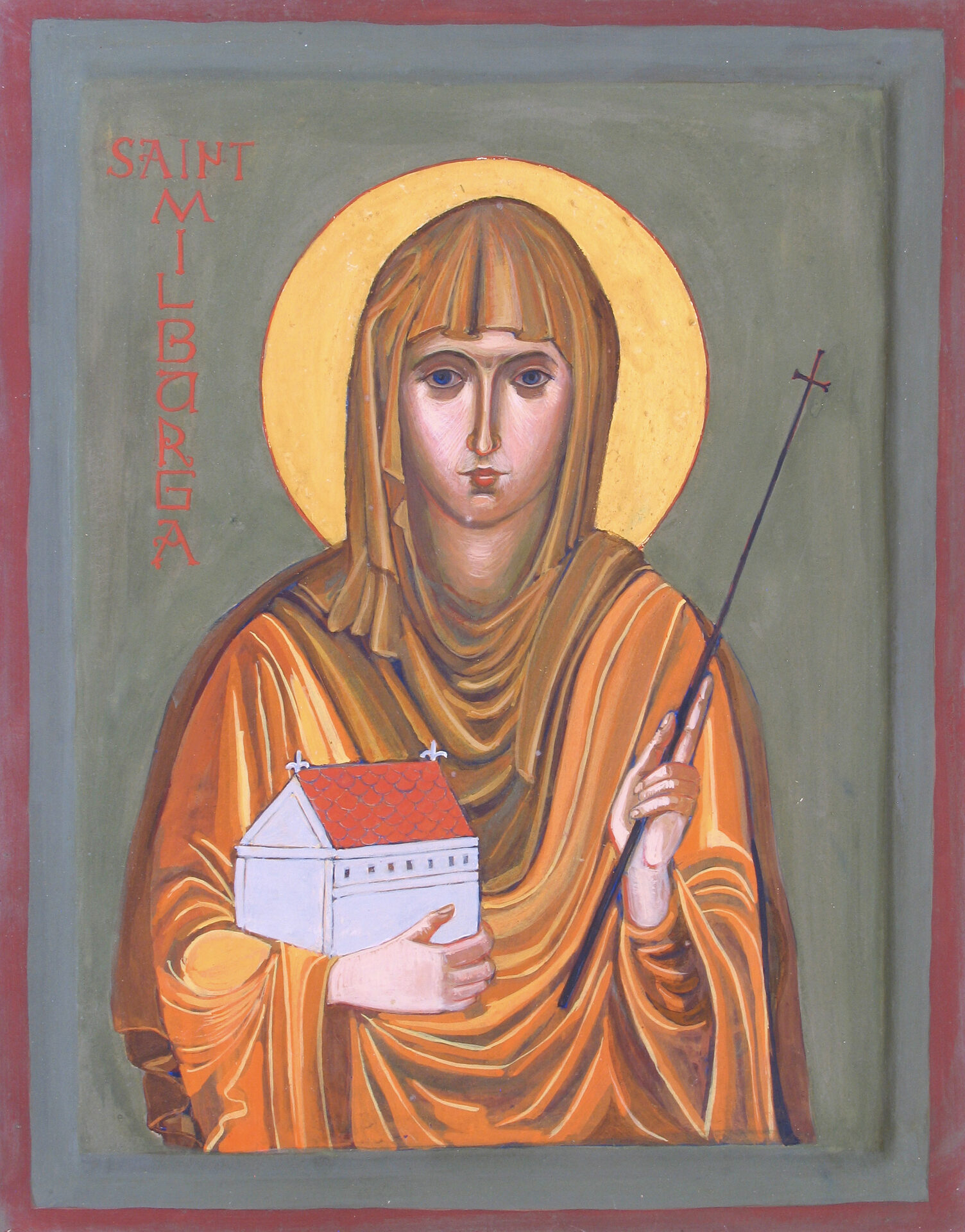
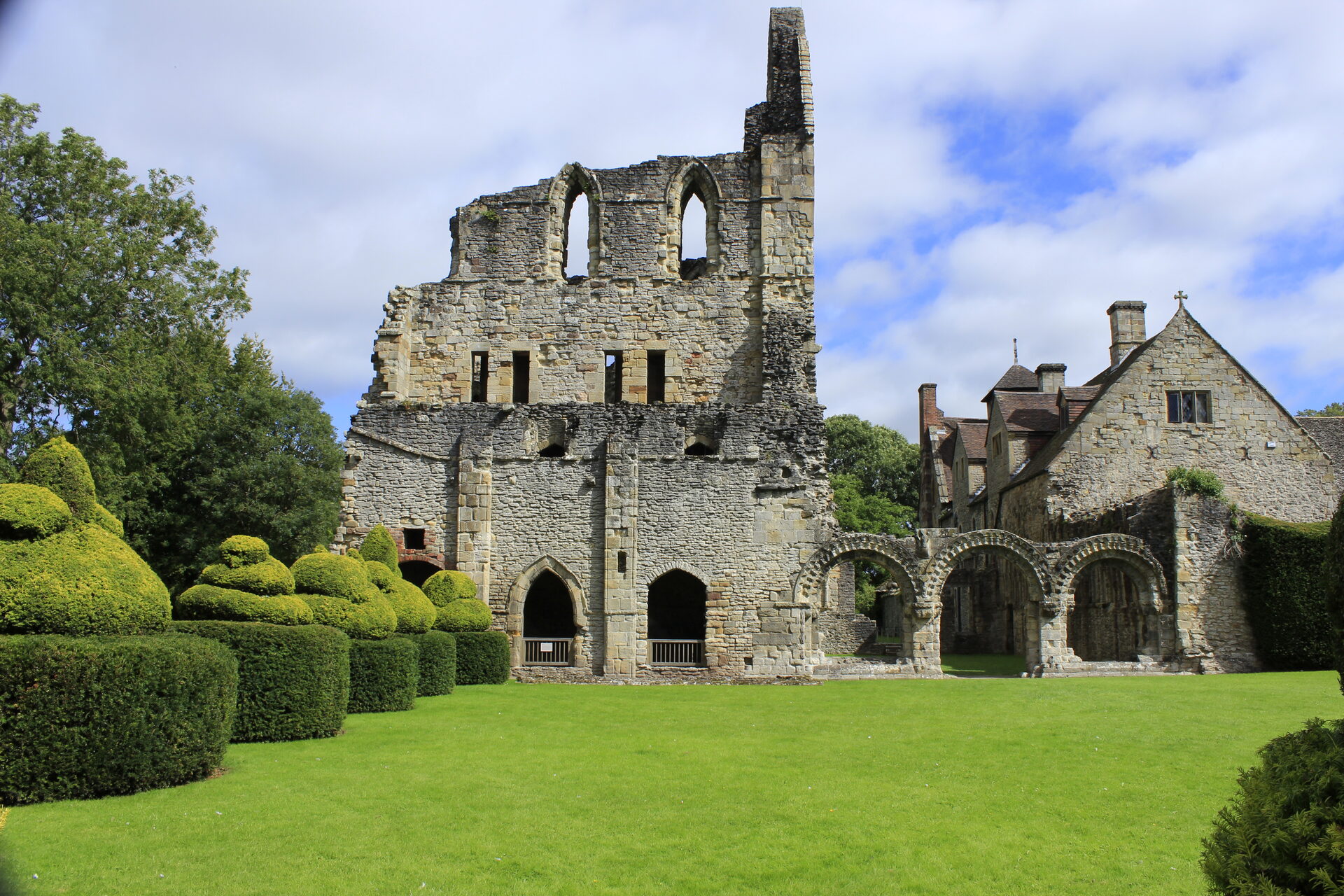
Saint Milburga, a granddaughter of the pagan warlord Penda of Mercia, was of the second generation of Christian converts in the Midlands. Her father, Merewald, after his baptism established Wenlock Abbey for her and sent her and her sisters to Merovingian Gaul for their noviciate. As abbess of this double monastery, Milburga became greatly beloved throughout Mercia as a spiritual mother, teacher, wonderworker, and healer. She fell asleep on the twenty-third of February, in the year 722, and was buried by the altar of the Holy Trinity in the monastery church.
Much of the monastery was destroyed when the Danes overran Western Mercia in 874. Monastic life was partially restored before the end of that century and continued in diminished form into the tenth, but eventually the last of the nuns died, their church fell into abandonment, and the whereabouts of the saint’s tomb was forgotten. The men’s church was restored by Earl Leofric of Mercia around 1050, and in 1079 the new Norman Earl of Shrewsbury, Roger de Montgomery, brought Benedictine monks from La Charité-sur-Loire in France to re-establish the monastery as a daughter priory.
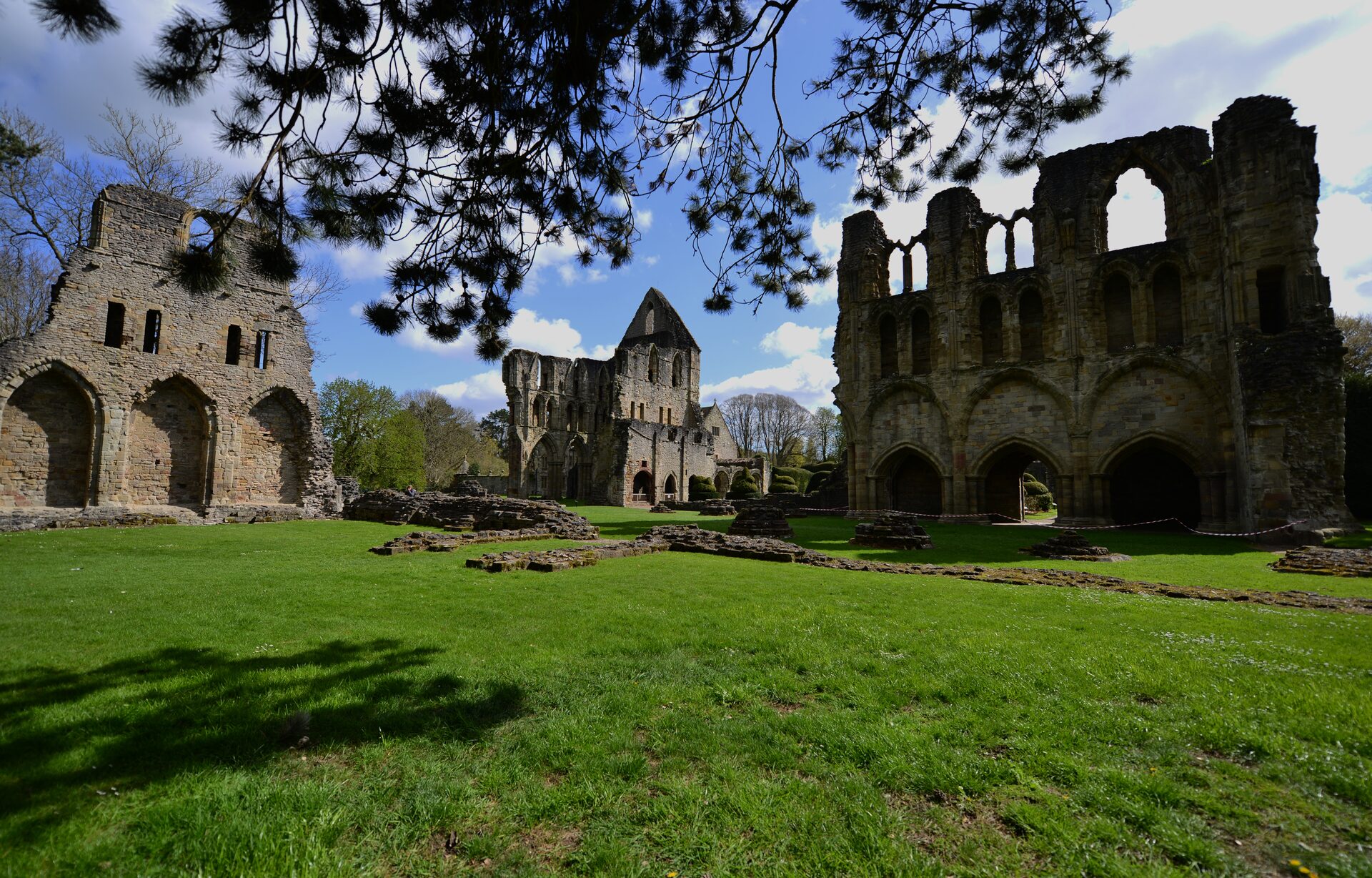
The new monks inherited a silver casket said to contain the saint’s relics, but on examination it held only ashes and rags, secondary relics from which the primary relic had long since been removed. Hope revived when Raymond, a workman restoring the old nuns’ church, discovered in an old box a document written in Old English, in which a priest named Alstan attested that the body of the saint lay buried near the altar. The monks began excavating and wrote to Saint Anselm, Archbishop of Canterbury, for a blessing to proceed.
On the Vigil of the Feast of the Nativity of Saint John the Baptist, the twenty-third of June 1101, while the brethren were chanting Matins, the workman Raymond came to the prior’s stall and reported that two boys playing on the excavation site had fallen up to their knees into a circular pit. The prior went to investigate by torchlight but could discern nothing in the darkness; he returned to the service and assembled a work party in the morning. As they dug, …a sweet odour of balsam arose from the earth, and the bones — described by the monks as beautiful and luminous — were brought to light, together with iron bands from the original coffin. Further excavation revealed the foundations of the altar, confirming the ancient priest’s testimony.
On the third day, the twenty-fifth of June, the brethren came in white vestments and bare feet, reverently washed the holy bones, and placed them in the restored shrine. Miracles followed immediately. A patient who had suffered five years of illness drank water in which the saint’s bones had been washed and was healed. A twelve-year-old girl afflicted with leprosy, laid beside the altar at the beginning of Vespers, was entirely cured before the service ended. The blind and the leprous especially received graces through her intercession. On the Feast of the Presentation of the Lord, the second of February 1102, the relics were translated in solemn procession to the new monastery church. The shrine of Saint Milburga became one of the great pilgrimage destinations of medieval England, until her relics were destroyed in 1547 when they were burned outside the abbey gatehouse in the reign of King Edward VI.
Through her holy intercessions, Christ our God, have mercy on us and save us. Amen.
Apolytikion, Mode iv Ταχὺ προκατάλαβε
The Lord did reveal to us * as an invaluable pearl * that was hidden in the earth * your relics to all in need * giving forth streams of miracles; * wherefore, bless’d Milburga, * supplicate Him, we beg you, * to save from tribulations and temptations and dangers, * adornment of all Shropshire, * those gladly praising you.
Kontakion, Mode iv. You appeared today
We observe the holy feast, Mother Milburga, * of the finding of your bones, * Abbess most prudent and devout, * and we cry out to you lovingly: * Rejoice, Shropshire’s * protection invincible.
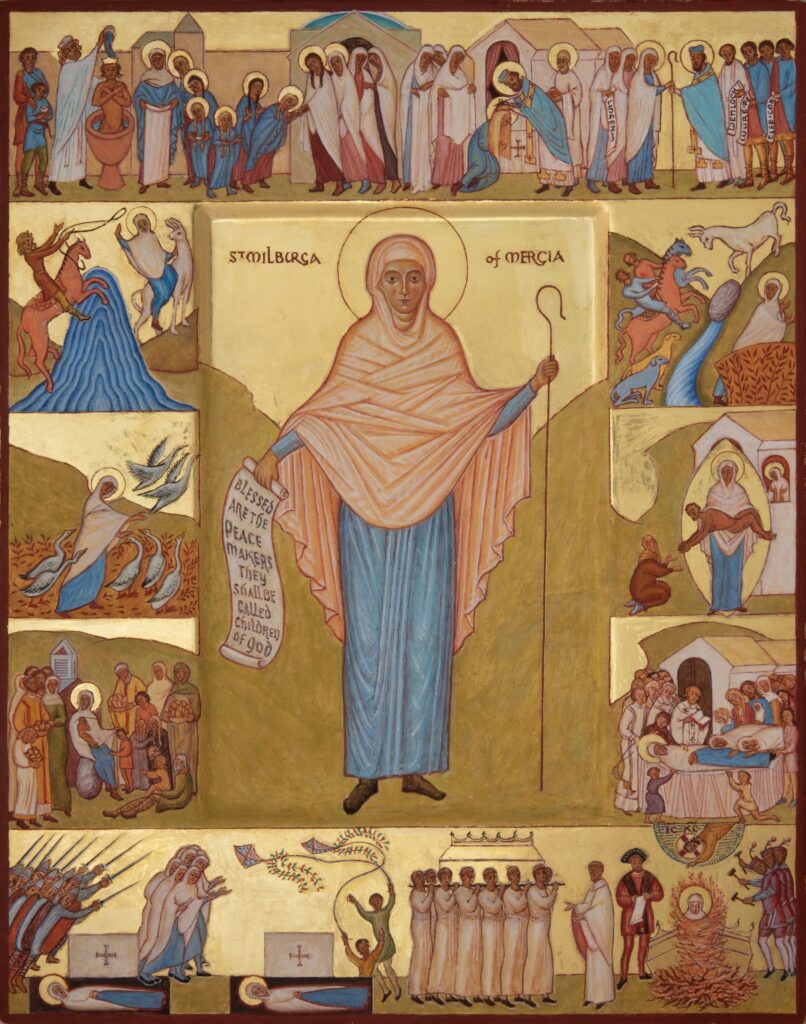
In the video below, Sister Theovouli explains the life of St Milburga through her icon.
Notes
1. La Charité-sur-Loire: a major Cluniac Benedictine priory in Burgundy, France, from which the monks who refounded Wenlock came. The reformed Cluniac observance was noted for its elaborate ceremonial and high standard of choral prayer.
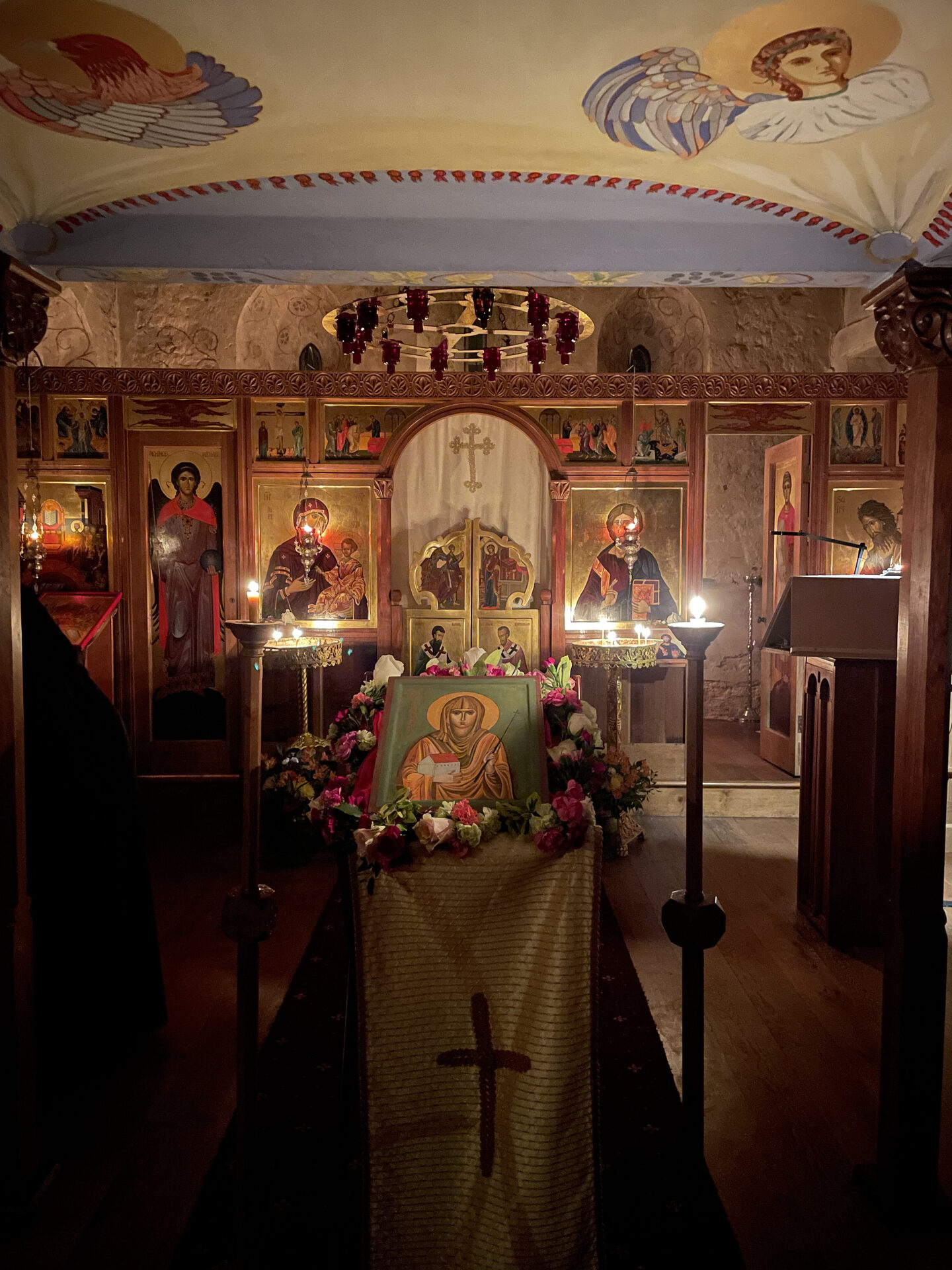
2 The Orthodox Community of the Holy Fathers of Nicaea restored the derelict ancient church on Saint Milburga’s estate at Sutton, Shropshire, in the 1990s.
Full lives of St Milburga by Chris Jobson and Sister Theovouli
Christopher Jobson and Sister Theovouli have written more detailed accounts of Saint Milburga’s life. See below – and if you find it valuable, please consider making a donation to support the work of Shrewsbury Orthodox Parish.