Synaxarion
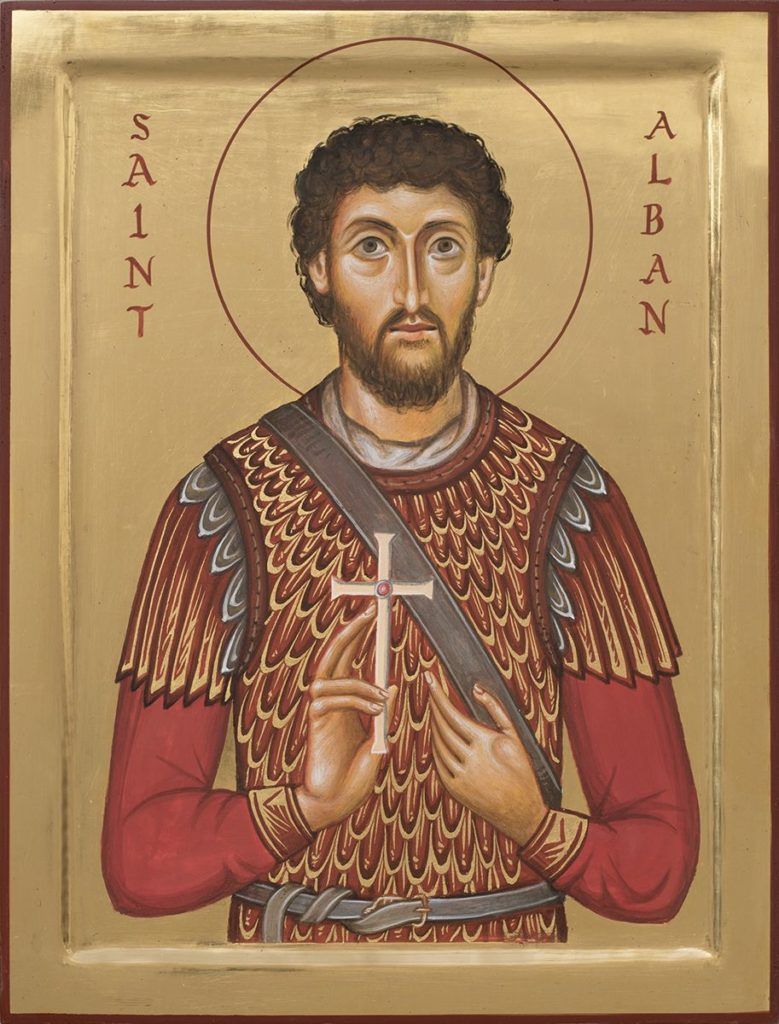
The holy martyr Alban was a Romano-British soldier living in the city of Verulamium — now Saint Albans in Hertfordshire — the first major town on Watling Street, the great road running north-west from London into Wales. He lived during one of the Roman persecutions of the Christians, either that of Septimus Severus in the early third century or that of Diocletian at its close; the ancient sources themselves differ on this point.
During the persecution, a Christian priest named Amphibalus, a native of Wales, fled to Verulamium while serving in the region of Caerleon. He found refuge in the house of Alban, who was at that time still a pagan. Alban was struck by what he observed: the priest engaged in “continual prayer, watching day and night.” Intrigued by this way of life, he began to receive instruction from Amphibalus and to imitate his manner of living. Illumined by the grace of God, Alban was converted and became a Christian in all sincerity of heart.
When soldiers came to the house to seize the priest, Alban clothed himself in Amphibalus’ garment and presented himself to the soldiers in his place. He was arrested, brought before the magistrate, and when his deception was discovered, was commanded to sacrifice to the pagan gods. Alban refused, declaring himself a Christian. The magistrate, enraged, condemned him to receive the punishment destined for the priest.
As Alban was led to execution, a river lay across the road — swollen, according to some accounts, with an unusual throng of people wishing to witness his death. At his prayer the waters divided and he passed through on dry ground. The soldier appointed to execute him, struck with wonder at this miracle, threw down his sword and declared himself a Christian. A replacement was found, and Alban was led up the hill — now known as Holywell Hill — above Verulamium. There he prayed for water, and a spring burst forth from the hilltop. He was beheaded on the summit, and in that moment the eyes of the executioner fell to the ground, so that he died with his victim. Flowers bloomed where the martyr’s blood fell upon the ground.
The shrine of Saint Alban at Verulamium was already a place of veneration within living memory of his death, and it survived — unlike many British shrines — the subsequent Saxon conquests. The great abbey church built above his tomb by the Normans still stands; it became, and remains, the Cathedral of Saint Albans. In the fifth century, when Saint Germanus of Auxerre visited Britain to combat the Pelagian heresy, he made a pilgrimage to Alban’s shrine and took soil from the holy place back to France. Saint Alban is venerated as the first martyr of Britain.
Notes
The date of Saint Alban’s martyrdom has been disputed since antiquity. The oldest manuscript of the Passio Albani (the Turin version, 6th century) gives the reign of Septimus Severus (193–211); Bede, following the less reliable Gildas, placed it under Diocletian (284–305). Most modern scholars favour the Severan date, since Severus issued an edict forbidding conversion to Christianity and was himself in Britain with his court from 209 to 211.
Verulamium: a major Roman city in the province of Britannia, the third largest in Roman Britain. It was situated near the site of the earlier Celtic settlement of Camulodunum (Colchester) and lay on the Via Watling, which was one of the principal Roman roads of Britain.
Amphibalus: the name given to the priest sheltered by Alban in mediæval hagiographical tradition, possibly derived from a misreading of the word amphibalus (a type of cloak) in early accounts of the martyrdom. He is himself venerated as a martyr; his feast is observed on the 25th of June.
Help support the ministries of the Parish: