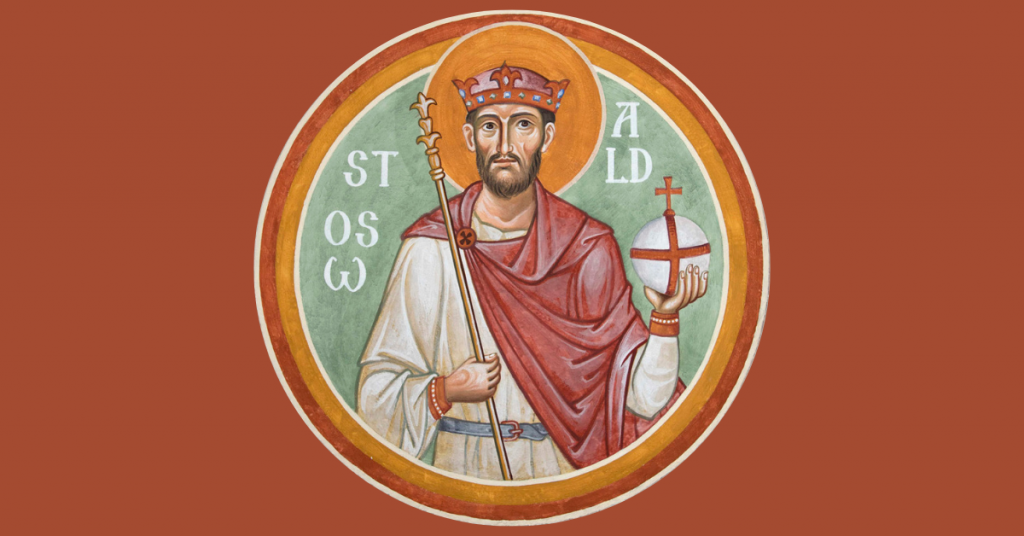
August 5th
Verses
Oswald whose name denotes “God reigns” perished in battle but in heaven now he reigns with God in glory.
On the Nones of August Oswald was slain in Maserfelth.
Synaxarion
Saint Oswald was born around the year 604, son of Æthelfrith the Ravager, King of Bernicia, and Acha of Deira. When his father was slain in battle by King Edwin in 617, the young prince fled with his siblings to the kingdom of Dal Riata, where they found refuge at the monastery of Iona. There he was baptised according to the rite of the Celtic Church and spent seventeen years in exile, being instructed in the Christian faith by the monks who were disciples of Saint Columba.
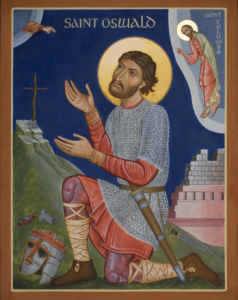
During his time at Iona, the prince developed such devotion to prayer that he would rise before dawn for the night office, and whenever he sat his hands would naturally rest upon his knees in the gesture of supplication to God.
In the year 634, when news came that the pagan alliance of Penda of Mercia and Cadwallon of Wales had slain King Edwin and were ravaging Northumbria with great cruelty, Oswald resolved to reclaim his father’s kingdom. Though he commanded only a small force against the vast army of his enemies, he trusted not in earthly might but in the power of Christ.
On the eve of battle, near Hadrian’s Wall at the place called Heavenfield, Oswald commanded that a great wooden Cross be erected. Holding it upright with his own hands while his men secured the base, he cried out: “Let us all kneel together and ask the true and living God to protect us from our enemies, for He knows we fight in a just cause.” All his warriors knelt and prayed together.
That night Saint Columba appeared to Oswald in a vision, covering the small army with his shining cloak and speaking the words of God to Joshua: “Be strong and act manfully. You shall conquer and reign.” In the morning Oswald told his army of the vision, and they promised to seek baptism after the victory.
At dawn the battle was joined, and though vastly outnumbered, Oswald’s forces were victorious. Cadwallon was slain and his army routed, and the people hailed Oswald as “Whiteblade,” seeing in him the instrument of divine justice.
Becoming king of both Bernicia and Deira, Oswald immediately sent to Iona requesting missionaries. When the first monk proved too harsh with the people, the community chose Aidan, who established his episcopal see at Lindisfarne. Since Aidan spoke only the Celtic tongue, King Oswald served as his interpreter, which greatly impressed the people and hastened their conversion to the faith.
The friendship between king and bishop became renowned. Oswald’s charity knew no bounds – on one Easter Day he gave his feast to the poor and commanded that his silver dish be broken up and distributed among them. Bishop Aidan, moved by this generosity, grasped the king’s right hand and exclaimed: “May this hand never perish!” – and indeed it was found incorrupt long after his death.
For eight years Oswald ruled as Bretwalda, using his authority not for earthly glory but to spread the Gospel and establish Christian peace throughout his realm. He stood as godfather when King Cynegils of Wessex was baptised, and founded many churches and monasteries.
But Penda of Mercia, master of the old pagan mysteries, could not endure the growth of Christ’s kingdom. In the year 642 he gathered a great army and met Oswald in battle at Maserfield. Seeing his forces surrounded and defeat certain, the holy king cried out as he fell: “God have mercy on their souls!” A sword stroke to the head ended his earthly life, and he was thirty-eight years old.
Following pagan custom, Penda dismembered the body and hung the limbs on stakes. But a great raven carried away the blessed right arm to an ash tree, where it fell and a healing spring gushed forth. The place where the king’s blood touched the earth became greener than the surrounding field, and many miracles were worked there. Pilgrims came to take soil from the spot, mixing it with water to heal the sick, until a great pit was formed.
His relics were later recovered and distributed throughout Britain and beyond, and his veneration spread across Europe. The head was placed with Saint Cuthbert’s relics at Durham, where it remains to this day. He became the model of Christian kingship, and through his intercessions many miracles were worked.
Through his holy intercessions, Christ our God, have mercy and save us. Amen.
Read more about his life here
Troparion in the Fourth Tone. Spec. Mel.: “Ταχύ προκατάλαβε”
The glory of pious kings * and fearless warrior of Christ, the teacher of godliness * and helper of those in need, with hymns let us gladly praise, * Oswald the Passion-bearer, Oswestry’s holy patron * the martyrs’ imitator * and the joy of all England, * who to all that reverence him, * gushes forth streams of cures.
Kontakion in the Third Tone «Ἡ παρθένος σήμερον»
At all times lifting your hands * you prayed with awe and compunction, * most sincerely giving thanks * to your Creator and Saviour, * pious king * Oswald, companion of holy martyrs; wherefore, God * received you in His eternal kingdom; * where with angels now rejoicing * praying without ceasing * for us who invoke your help.