
On the twenty-third day of February, memory of our Venerable Mother Milburga, daughter of the king of Mercia, abbess of Wenlock, the wonderworker.
Verses
Mild the wild geese became, holy Milburga, once you commanded them and stopped to harm the corncobs. On the twenty-third, Milburga departed to be with Christ.
Synaxarion
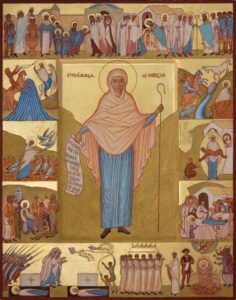
Our Venerable Mother Milburga was born in the year 664 to King Merewald of the Magnosaete and Queen Ermenburga, the granddaughter of King Ethelbert of Kent. Her father, having been baptised by the Northumbrian monk Edfrid, desired that his daughters should follow the monastic life. When Milburga reached the age of twelve, she was sent with her younger sisters to the monastery of Chelles in Gaul, where she received her monastic formation under the guidance of the holy Abbess Bertille.
After six years of training in the continental tradition, the blessed Milburga returned to Mercia at the age of eighteen. Her father had established for her a double monastery at Much Wenlock, following the rule and customs of the great monasteries of Gaul. Archbishop Theodore of Canterbury installed her as abbess of this foundation, which became known as Wininicas, the White House, built of local limestone.
The saint governed her monastery with wisdom and gentleness, creating a paradise where the Lord had planted the fairest flowers and sweetest fruits. Under her rule, the monastery became a centre of learning and missionary activity, with schools for both boys and girls, following the pattern of the great Irish foundations.
Being of great beauty and travelling frequently throughout her extensive territories on pastoral visits, the blessed Milburga faced many dangers from pagan men who sought to dishonour her. Yet the Lord protected His servant through many miracles. When pursued by an amorous prince at Corve Dale, the waters rose up behind her as she crossed the river, preventing his horse from following. At Llandemylien in Wales, a pagan king bent on assault was struck down by divine judgement. At Stoke St. Milborough, when fleeing from her enemies, her mule struck a stone with its foot and water gushed forth, delaying her pursuers whilst she blessed a field of barley that miraculously sprang up and ripened.
The saint was greatly beloved by the farmers of the Midlands, who invoked her intercession against birds that ravaged their crops. At Wedon in Northamptonshire, when the fields were being destroyed by flocks of wild geese, she sent her servant to bring back the errant birds. They came before the servant like captive sinners with bowed necks, and at the saint’s word departed and did not return to trouble the crops again.
Many signs accompanied the blessed Milburga’s prayers. She was often seen surrounded by Divine light that appeared like flames, yet neither she nor those near her were burned. Once, when her veil was wet, she hung it upon a ray of this heavenly light to dry, so absorbed was she in contemplation of the Lord.
After many years spent in good works and ascetic struggles, the saint was purified by long and painful illnesses. Sensing her approaching end, she called together the whole community and set before them the words of the Beatitudes: “Blessed are the pure in heart, for they shall see God. Blessed are the peacemakers, for they shall be called the children of God.” She exhorted them to choose the most godly sister among them to take her place, and having received the holy sacraments, she surrendered her soul into the hands of her Maker on the twenty-third day of February in the year 722.
Through her holy intercessions, Christ our God, have mercy on us and save us. Amen.
Apolytikion
You scorned the love of the world * and earthly riches and fame; * and you were betrothed to Christ, * whom you did serve all your life * by vigils and abstinence; * hence, you were duly honoured, * by your Heavenly Bridegroom, * who gave you the crown of glory * and the power of healing. * Do now beseech Him, Mother Milburga, * that our souls be saved.
Another Apolytikion
Shropshire does rejoice * in you, Milburga, * and acknowledges * you as its helper, * the wondrous Abbess of Wenlock and bride of Christ. * Thus, as you once did expel the ferocious fowls, * and kept undamaged the crops from their ravaging, * now likewise protect * from every danger, threat, and constraint * those who with faith and love honour your memory.
Kontakion
Having left the royal house, * you did abhor all vainglory, * and you were betrothed to Christ, * the King immortal and holy; * you shone forth * in self-denial, prayer and fasting; * hence you earnt, * the incorruptible crown of glory, * ornament of the monastics, * Mother Milburga, * the glory of all Shropshire!