The little we know about Saint Alchmund (or Ealhmund) comes from the late twelfth-century chronicle attributed to Simeon of Durham that seems to draw on a set of York annals 703-802. Alchmund was the second son of Alhred or Alchred who was the Christian king of Northumbria from 765 until Aethelred deposed him in 774. According to Simeon he fled to the kingdom of the Picts where he and his family were given refuge in the court of King Ciniod. In the ensuing dynastic struggles Alchmund returned to Northumbria with some forces where, after some initial success, he was killed around 800. There is some confusion among the chroniclers as to the mode and the date of his death. However, in his Historia Regum Simeon records that:“In 800 Alkmund, as some say the son of King Alhred of Northumberland was seized by the guards of King Eardwulf and by his order killed along with some of his fellow-fugitives.” Within a short space of time he was honoured as a saint and recorded in an anonymous 9th century treatise that contains a list of saints’ resting places. In this treatise his relics were said to lie in a minster at Northworthy (Derby), ‘beside the River Derwent’.

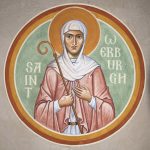 Werburgh, a princess of Mercia, exchanged her coronet for a veil early in life and became a great foundress and leader of monastic communities in East Anglia and Mercia. Her greatness in life is reflected in her veneration in death. Her holy body, jealously guarded by her monastic community in Triccingham, was given up through a miracle when the locks fell away and she was borne by monks to Hanbury, her desired resting place. But it was Aethelflaed – Lady of the Mercians – who most likely delivered her relics to Chester – the city of her patronage – and established her veneration in Shrewsbury. In Chester she delivered the city from fire and perils inflicted by barbarian invaders. In Shrewsbury her veneration was joined with that of the royal saints
 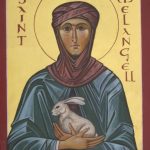 Little known outside Wales and Great Britain, the secluded Welsh shrine of St. Melangel, deep in the Berwyn Mountains, is dedicated to a sixth-century Irishwoman, an anchorite who lived here for many years, alone and unknown. An early Christian treasure, it is the oldest existing Romanesque shrine in northern Europe. When the church was restored in the 1960’s, Melangell’s relics were discovered under the chapel floor, and now more than 10,000 pilgrims a year come to ask for her intercession.
 When Oswald became the first Christian king of Northumbria he sought the aid of the monks of Iona, the disciples of Columba, for the conversion of the Saxons of the North.